
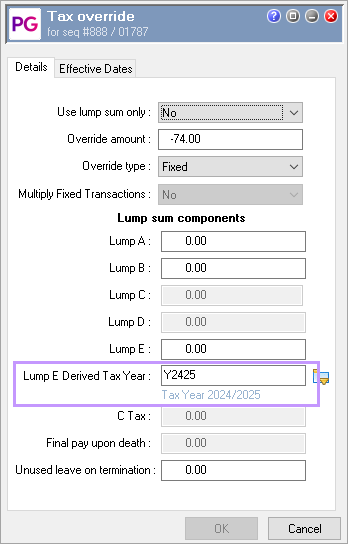
When you enter a Tax Override transaction in an Australian (AU) database, you will see a field called Lump E Derived Tax Year.
What is it for?
-
This field tells PayGlobal (and the ATO) the tax year in which the original payment, now being corrected with an arrears payment, was made.
-
For example, if you are paying arrears for a prior year’s lump sum payment, use this field to specify the relevant tax year.
How does it work?
-
The Lump E Derived Tax Year field will always default to the most recent previous tax year.
-
For example, if the current year is 2025/2026, it will default to 2024/2025.
-
When should you use it?
-
This field is only relevant if you enter a value in the Lump E field above it (i.e., if you are recording a Lump Sum E).
-
If you do NOT enter a Lump E value, any entry in the Lump E Derived Tax Year field will be ignored.
What is Lump Sum E?
-
Lump sum E is an amount of back payment of remuneration that accrued, or was payable, more than 12 months before the date of payment.
Ensure the tax year entered relates to when the original payment was earned, not when the correction is being processed.