
The tax code recorded for an employee determines how PayGlobal calculates deductions. Make sure the employee provides the correct tax code on their tax code declaration and that it is recorded accurately in PayGlobal. Using an incorrect tax code may result in the wrong amount of tax being deducted and could lead to an end-of-year tax bill.
For information about which New Zealand tax code applies, including the current tax codes, income thresholds and student-loan considerations, see Inland Revenue’s About tax codes page.
Updating tax codes
Once the employee has completed their tax code declaration, use the instructions below to record the tax code in PayGlobal. PayGlobal does not determine which tax code applies; select the code provided by the employee on their declaration.
To select an employee's tax code
-
Open the employee's record.
-
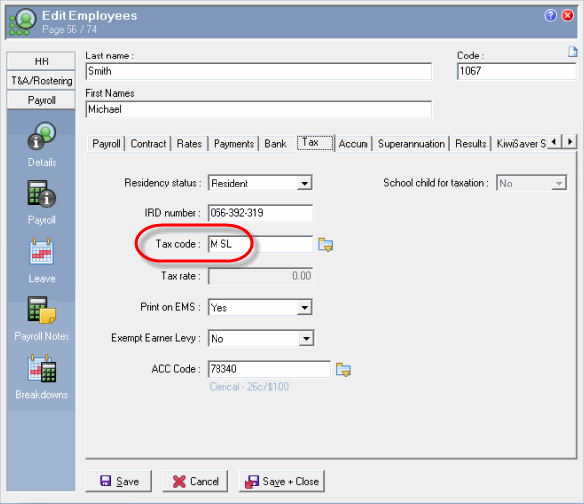
Navigate to Payroll > Payroll > Tax tab.
-
In the Tax code field, double-click M SL.
-
Click Save + Close.
Inland Revenue states that the employee is responsible for ensuring that the employer has selected the correct tax code in the employee’s record.
Student loan tax codes
If an employee needs to make student loan repayments, you must select the relevant Tax code in their record. Tax codes with "SL" indicate that an employee has a student loan. For example, Michael Smith's tax code is M SL.
The main-income tax codes apply the student-loan repayment threshold. Student-loan repayments are calculated only on the employee’s gross earnings above the threshold.
The secondary-income and STC SL tax codes do not apply the student-loan repayment threshold. Student-loan repayments are calculated on the employee’s total gross earnings for the pay period.
SL Tax Codes and Pay Processing
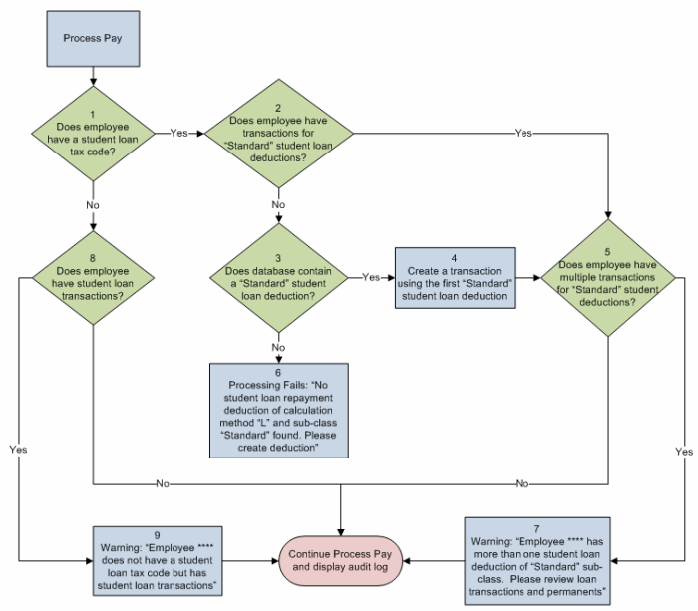
The following flowchart shows the initial checks that PayGlobal makes when you process student loan transactions.
Warnings
If the employee has student loan transactions, but they do not have a student loan tax code, the pay is processed and the following warning (Step 9) appears in the audit log: "Employee **** does not have a student loan tax code but has student loan transactions."
If the employee has multiple "Standard" student loan deduction transactions, the pay is processed and the following warning (Step 7) appears in the audit log: "Employee **** has more than one student loan tax code deduction of "Standard" sub-class. Please review loan transactions and permanents."
If the employee has a "Standard" student loan deduction transaction, but the database does not contain a "Standard" student loan deduction, the pay is not processed and the following warning (Step 6) appears in the audit log: "No student loan repayment deduction of calculation method “L” and sub-class “Standard” found. Please create deduction."
Process pay
When you process a pay for an employee with an SL tax code, PayGlobal checks (Step 2) whether the employee has any deduction transactions (entered manually, imported or from permanents) with:
-
Calculation method = "L. Student loan"
-
Deduction class = "S. Student loan reduction"
-
Sub-class = "Standard"
If the employee has a transaction for this type of deduction, then PayGlobal checks (not in flowchart) whether the transaction has a non-zero value in the Percentage field. See Student loan transactions – percentage field (New Zealand).
-
If the transaction has a non-zero Percentage value (such as 5.0000), then PayGlobal processes the student loan transaction based on this Percentage value. For example, a Percentage value of 5.0000 would result in a 5% student loan transaction. See Special Tax Codes and Student Loans Process.
-
If the transaction has a zero Percentage value (0.0000), then PayGlobal automatically processes the student loan transaction based on the standard 12% student loan transaction.
If the employee does not have this type of deduction transaction, then PayGlobal automatically creates a 12% student loan transaction (Step 4) using the first Deduction record with:
-
Calculation method = "L. Student loan"
-
Deduction class = "S. Student loan reduction"
-
Sub-class = "Standard"
See Standard Process.